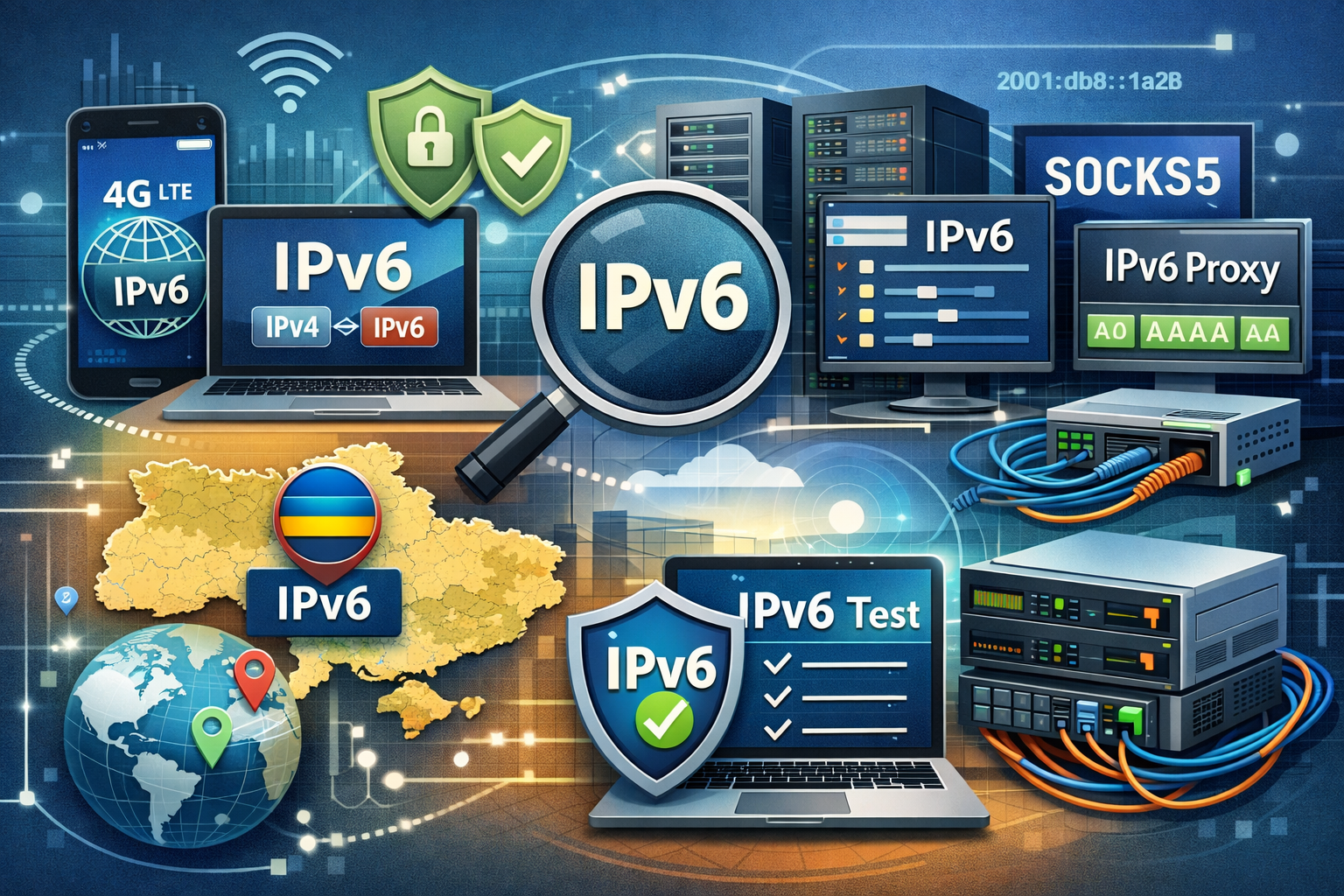
Why IPv6 became a practical issue for mobile proxies in 2026
IPv6 is no longer “only an ISP topic”. In 2026, IPv6 is often enabled by default in mobile networks, and many apps and browsers will prefer IPv6 when it is available. That changes how mobile proxy setups behave: you can get IPv6 leaks, IPv4/IPv6 mismatches, inconsistent geolocation, and extra network signals that feed into fingerprinting and risk scoring.
The core risk is that many proxy chains only cover IPv4 traffic, while IPv6 traffic may go out directly. For predictable results, you must understand dual-stack behavior, AAAA DNS answers, and where your traffic can bypass an IPv4-only proxy.
Dual-stack in mobile Internet
Dual-stack means a device has both IPv4 and IPv6 connectivity. A client may choose either protocol based on DNS answers and its own connection strategy. RFC 8305 (Happy Eyeballs v2) describes trying IPv6 and IPv4 almost in parallel to reduce delays when IPv6 is unreliable.
Mobile operators also deploy transition models where the network is IPv6-first (or partly IPv6-only) and IPv4 reachability is provided via NAT64/DNS64 or 464XLAT. 464XLAT is a well-known mechanism in IPv6-oriented mobile deployments for keeping IPv4-only services reachable.
NAT64/DNS64 and 464XLAT: what changes for proxy setups
With DNS64, a resolver can synthesize AAAA answers from A records, and NAT64 then translates IPv6 to IPv4 for IPv4-only destinations. This affects observable DNS behavior and can influence protocol selection in clients.
464XLAT helps preserve IPv4 application compatibility in IPv6-oriented networks and is commonly discussed for mobile deployments.
IPv4/IPv6 mismatch: “two realities” in one session
If your proxy provider gives you a mobile IPv4 endpoint (e.g., SOCKS5) while IPv6 remains enabled on the client, some connections may go over IPv6 and bypass the IPv4 proxy—especially when AAAA answers exist. AAAA records are the standard DNS record type for IPv6 addresses.
IPv6 leaks: where they typically show up
- WebRTC: ICE candidate discovery can reveal real interface/public addresses (IPv4/IPv6) even if web traffic uses a proxy.
- DNS64/NAT64 patterns: synthesized AAAA responses and NAT64 prefixes can change what services observe.
Validate IP/DNS/WebRTC leakage using dedicated leak test pages.
Service support and scenario stability
Major platforms and CDNs broadly support IPv6. Google publishes an IPv6 availability graph, and Cloudflare has published traffic-based estimates for IPv6 adoption.
Still, end-to-end behavior can be mixed: third-party APIs may remain IPv4-only, triggering NAT64/DNS64 or fallback. For proxy workflows, measure full user flows, not just “does the homepage load”.
Geolocation and fingerprinting impacts
IP geolocation is database-based, not GPS. With IPv6, large allocations and aggregation can lead to less consistent city-level results, and different databases may disagree. MaxMind discusses IPv6 geolocation considerations and accuracy limits.
- dual-stack adds signals such as address family preference, DNS patterns, and WebRTC candidate exposure,
- IPv6 protocol specifics are described in the IPv6 specification.
How to test IPv6 and leakage in 2026
- confirm IPv6 connectivity on the device/gateway;
- check external IPv4/IPv6, DNS and WebRTC on leak tests;
- confirm whether AAAA answers and DNS64 patterns exist;
- compare IPv4 vs IPv6 geolocation across more than one database.
Risk reduction strategies
- Controlled IPv4-only client: if your proxy is IPv4-only, disable or firewall-block IPv6 to prevent bypass/leaks.
- Dual-stack proxy/tunnel: route both IPv4 and IPv6 via a single managed egress point.
- Full tunnel (VPN/WireGuard/OpenVPN) with IPv6: often the easiest way to keep everything consistent, including DNS behavior.
Takeaways
Mobile IPv6 is the default reality. For proxy workflows it brings benefits (IPv6 service compatibility, sometimes better paths) and new problems (IPv6 leaks, IPv4/IPv6 geo mismatch, extra fingerprint signals). The fix is operational: define your target (IPv4, IPv6, or both), measure real behavior, and enforce routing plus regular checks for IP, DNS, and WebRTC leakage.